The Trillion Dollar Body: Cooperative Economics and the Sovereignty Loop

The Trillion Dollar Body: Healthcare is a trillion dollar economy, and every appointment exports Black wealth. Healthcare Sovereignty, Vol 5, turns health spending into community ownership.

The Black Metrics

6/22/20266 min read

The Sovereignty Series • Volume 5

The Trillion Dollar Body: Cooperative Economics and the Sovereignty Loop

Healthcare is not only about medicine. It is one of the largest sectors of the modern economy, a market measured in trillions of dollars every year. That fact reframes everything. When a community relies entirely on outside providers, it exports both its wealth and its power with every appointment, every prescription, and every premium it pays.

This is the same value extraction that defines Black economic life across every sector. Care is delivered, money is spent, and the wealth generated by that spending accumulates somewhere else. Healthcare Sovereignty, Volume 5 of The Sovereignty Series, turns that flow around by treating health not only as a service to be received but as an economic engine to be owned. This article covers the two chapters where the medicine meets the money.

Why Illness Becomes Ruin

Health is expensive and unpredictable, which is exactly why it is one of the largest drivers of debt and ruin in Black communities. When a community carries that risk individually, a single illness can erase a family's savings in weeks. When the risk is pooled, and the pool is owned by the community, the same illness is absorbed by a system designed to absorb it.

This is not a new idea. It is one of the oldest tools in the Black tradition of self sufficiency. Long before modern insurance, mutual aid and benefit societies pooled contributions to bury the dead, support the sick, and care for widows and orphans when no one else would. Cooperative economics in health is the inheritance of that tradition, modernized.

The Cooperative Toolkit

Shared risk pools. Community owned health cooperatives and mutual aid structures that pool contributions to cover care, so that risk is shared among members rather than priced against them by outside insurers. When the pool is member governed, surpluses are reinvested in the community rather than extracted as profit.

Collective bargaining. A cooperative of clinics and practices can negotiate as a single entity for supplies, equipment, malpractice coverage, and services, securing rates that no individual practice could obtain. Scale is the lever, and cooperation creates scale.

Pooled investment. Aggregated community capital can finance the clinics, equipment, and facilities that individual contributions never could, generating recurring value that is then reinvested into expansion.

How a Cooperative Actually Lasts

A health cooperative is a structure, and structures require discipline. Romance does not keep a pool solvent. Membership and governance must be clearly defined so the cooperative answers to its members. Contributions and benefits must be actuarially sound, because a pool that pays out more than it takes in collapses. Reserves must be built so the cooperative can weather a bad year. And outcomes must be measured, whether members are healthier, whether care is more affordable, and whether governance remains in community hands.

Effort, not idealism, is what sustains a cooperative. It requires people willing to administer it, members willing to contribute consistently, and leadership accountable for its solvency. Where it is built well, it converts the unpredictable catastrophe of illness into a shared and survivable system, and it keeps the value that would otherwise be extracted.

Begging the industry for better terms has never worked. The only escape is to own the pool.

From Spending on Health to Owning It

Pooling risk protects the community. Owning the full value chain of health builds wealth from it. To see the difference, follow a single dollar through two models of the same clinic.

In the extraction model, a community owned clinic refers its laboratory work, its imaging, its supplies, and its pharmacy to outside vendors. The margin on each of those services immediately leaves the community. The clinic may be Black owned, but it functions as a collection point that funnels wealth outward.

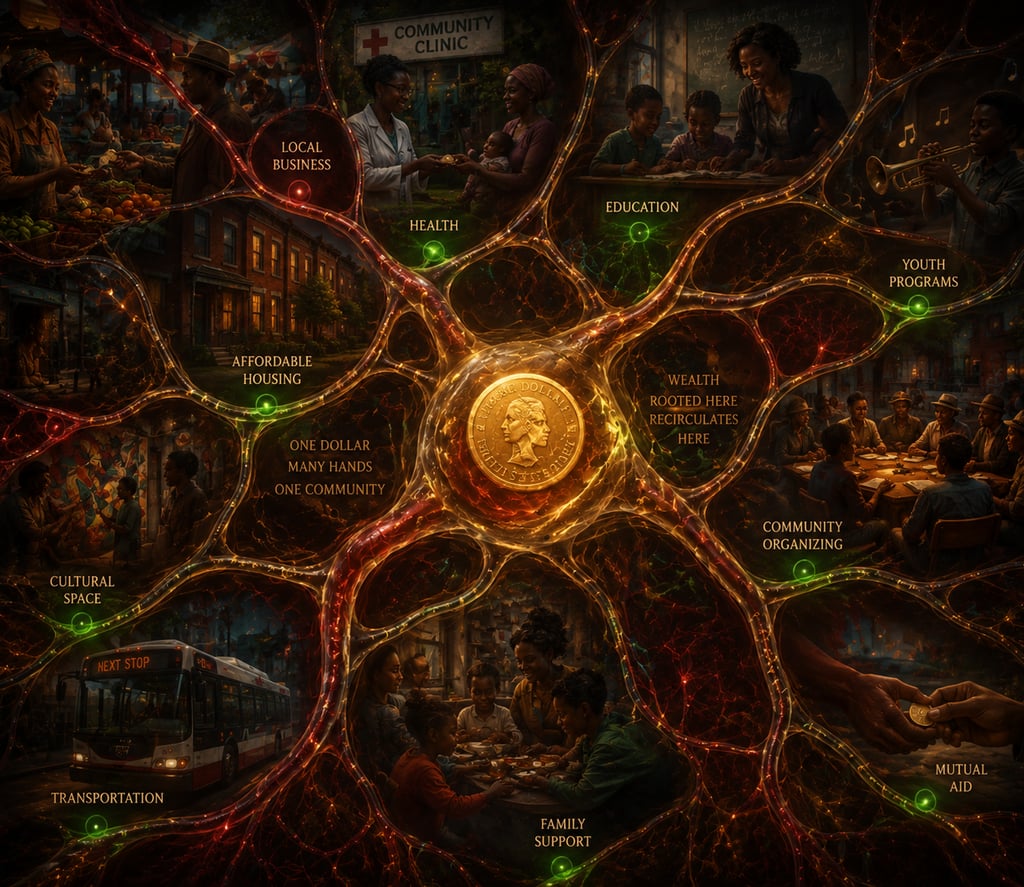
In the sovereignty model, the clinic is one node in a connected ecosystem. It sends its laboratory work to a community owned lab, sources from a community owned supplier, and refers patients to a community owned pharmacy and specialist network. The same dollar now circulates several times before it leaves, paying community wages and funding community institutions at each turn. The principle is simple and unforgiving. Every outsourced function is a potential point of value loss. Every internalized one is a point of wealth retention.

Every outsourced function is a point of value loss. Every internalized one is a point of wealth retention.

Capturing the Value Chain

Care delivery. Supporting Black physicians, nurses, therapists, and clinics so that the money a community spends on care circulates back into the community that spent it, rather than exiting after a single transaction.

Production. Building Black owned wellness, medical supply, and pharmaceutical ventures that pair rigorous science with cultural understanding, capturing the high margin stages of the health economy that are usually owned elsewhere.

Knowledge and technology. Owning the research, the data systems, and the health technology that the next generation of care will run on, so that innovation happens with the community rather than about it.

Case Study: The Sovereign Care Loop

Consider, as an illustrative strategic model, a community owned primary care clinic that deliberately builds its ecosystem inward over five years.

In year one it opens with community governance and diversified financing, so that no single funder can dictate its direction. In year two it partners with a community owned laboratory and a medical supply cooperative, keeping those margins internal. In year three it adds a community owned pharmacy, capturing the recurring revenue of prescriptions that previously flowed to outside chains. In year four it launches a telehealth arm that extends its specialists into surrounding areas and generates new revenue. By year five it is training community health workers and funding a modest research effort into the conditions most common among its patients.

At each stage, a function that would have exported wealth instead becomes an enterprise that retains it. The clinic has evolved from a service provider into an economic anchor that creates jobs, builds capacity, and funds its own growth. The lesson generalizes across the entire health economy. Control the middle, capture the margin, and ensure that every dollar spent on care strengthens the system that delivered it.

Scaling the Loop Across the Diaspora

A single sovereignty loop strengthens one community. Connected loops strengthen a people. The same logic that keeps a dollar circulating inside one neighborhood applies across borders, and the diaspora is the largest market the loop will ever have. A community owned clinic network in Atlanta, Kingston, London, Lagos, and Accra can pool purchasing power for supplies and equipment, share a common telehealth platform so specialists in one region serve patients in another, and route lab work and research through institutions the diaspora itself owns. Distance stops being a barrier and becomes a network. Each node keeps its own governance while gaining the bargaining power, the shared knowledge, and the resilience that only scale provides. The trillion dollar body is not confined to one country. Owned together across the diaspora, it becomes one of the most powerful economic engines Black people have ever held.

A loop that stops at one border leaks. A loop that spans the diaspora compounds.

Healing and Wealth Become One Act

The strategic shift is from spending on health to owning it. Every dollar a community pays for care it does not own is a dollar that funds someone else's institution and then leaves, and the health economy is measured in trillions of those dollars a year. Treating that spending as a pure expense is how a community can be both a massive market and permanently poor.

The alternative is to own the chain the spending flows through, so that the same dollar pays community wages, funds community research, and builds community capacity before it ever leaves. The returns are financial, but they are also structural. A community that owns its health economy can fund its own cures, govern its own institutions, and reproduce them across generations. Healing and wealth building stop being separate projects. They become one act of ownership.

The Bantaba: Questions for the Circle

  • Trace the last dollar you spent on health care. Where did it end up, and how many community hands did it pass through on the way out?

  • What would it take for your community to pool risk through a structure it actually owns and governs?

  • Which outsourced function in a local clinic, the lab, the pharmacy, the supplies, could be brought inside first?

  • Our ancestors built mutual aid societies with far less. What stops us from building them now, and is that obstacle real or inherited fear?

  • If healing and wealth building are one act, what is one enterprise your community could own that does both?

Recommended Reading

  • Collective Courage: A History of African American Cooperative Economic Thought and Practice by Jessica Gordon Nembhard.

  • The Color of Money: Black Banks and the Racial Wealth Gap by Mehrsa Baradaran.

  • Research on community development financial institutions and pooled community capital in health.

  • Healthcare Sovereignty: The Sovereign Body, Volume 5 of The Sovereignty Series by The Black Metrics, Chapters 6 and 7.

Own the Chain, Keep the Margin

The cooperative toolkit and the full Sovereign Care Loop are laid out step by step in Healthcare Sovereignty: The Sovereign Body, Volume 5 of The Sovereignty Series. The volume closes with a Strategic Assessment Checklist that lets you score your community's economic and cooperative sovereignty against twenty five concrete indicators.

Get Healthcare Sovereignty, Vol. 5

Next week: Whose Data Is Your Body. Sovereignty over the algorithm, the mind, and birth.

→ Watch the companion video on YouTube

The June Series: Healthcare Sovereignty

June 1 Surviving Sickness Is Not Sovereignty June 8 The Biology of OppressionJune 15 They Already Built the Blueprint June 22 The Trillion Dollar Body (You Are Here)June 29 Whose Data Is Your Body

THE BLUEPRINT

Contact

support@theblackmetrics.space

Copyright © 2026 The Black Metrics. All Rights Reserved.

The BlaCK METRICS

Fanbase Icon on footerFanbase Icon on footer
Spill app imageSpill app image