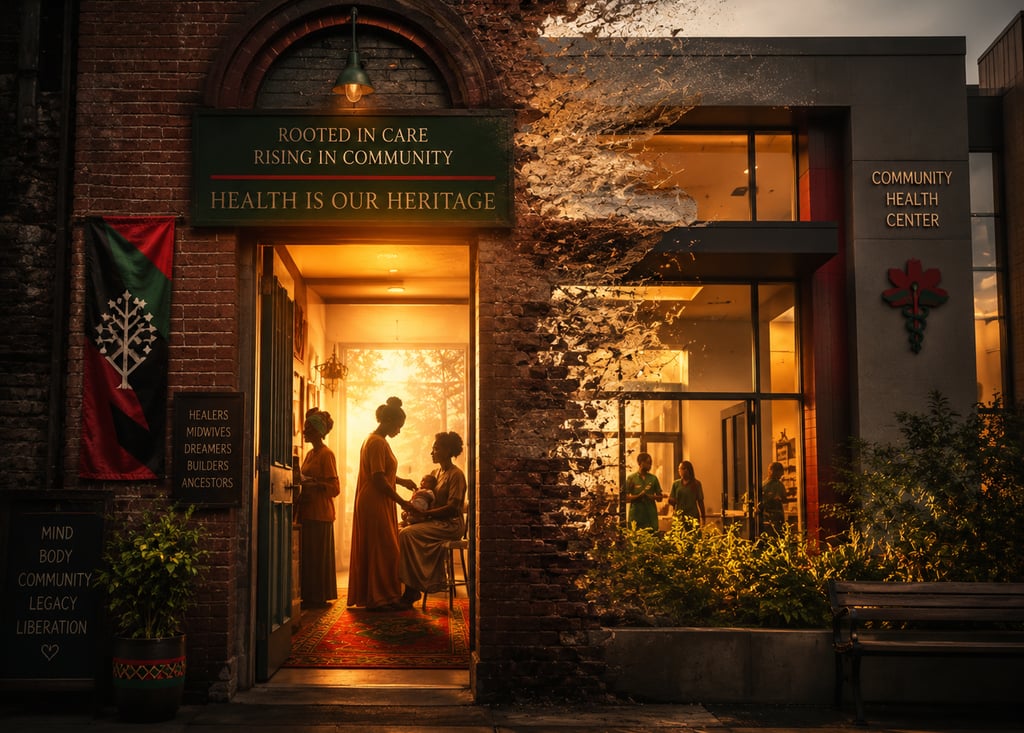
They Already Built the Blueprint: From the Panther Clinics to Mound Bayou

They Already Built the Blueprint: From the Panther clinics to Mound Bayou, Black communities already built owned care. Healthcare Sovereignty, Vol 5, shows how to build it again and keep it.

HEALTHCARE SOVEREIGNTY

The Black Metrics

6/15/20266 min read

The Sovereignty Series • Volume 5

They Already Built the Blueprint: From the Panther Clinics to Mound Bayou

When people hear the phrase healthcare sovereignty for the first time, the most common reaction is that it sounds impossible. A community owning its own clinics, training its own healers, governing its own care. Beautiful in theory, the thinking goes, but not something that has ever actually worked at scale.

That reaction is wrong, and the history proves it. Black communities have already built this, more than once, under far harder conditions than we face today. The models exist. The lineage is documented. What has been missing is not proof of concept. It is the decision to connect what was built into something permanent. This article walks through three of those proofs, drawn from Healthcare Sovereignty, Volume 5 of The Sovereignty Series.

First, the Theory: Control, Capacity, Continuity

Healthcare sovereignty is the collective ability of a community to determine the conditions, the institutions, and the priorities of its own health. It moves the conversation from seeking care to building the systems that deliver it. It rests on three pillars.

Control

The power to own and govern the institutions that deliver care, conduct research, and hold data. Without control, even well intentioned care drifts toward the priorities of whoever funds and runs it.

Capacity

The trained people and physical infrastructure required to heal ourselves. A community cannot govern what it cannot staff. Sovereignty without capacity is an empty mandate.

Continuity

The financial and cultural systems that let institutions survive across generations. A clinic that opens on a grant and closes when the grant ends has not produced sovereignty.

The implication is blunt. Access alone is a trap. A community with perfect access to a system built around someone else's priorities has achieved only a more efficient dependency. Inclusion asks permission. Sovereignty does not.

Inclusion asks permission. Sovereignty does not.

Proof One: The Black Panther Free Clinics

Between 1969 and the mid 1970s, the Black Panther Party operated free medical clinics in roughly thirteen cities, staffed by volunteer doctors, nurses, and health science students. These People's Free Medical Clinics offered preventive care, physicals, immunizations, and screenings, and they pioneered the use of community health workers, members of the community trained to deliver health and social services. They treated health as a right and built the capacity to deliver it outside a system the community had every reason to distrust.

Their most consequential campaign concerned sickle cell anemia. Recognizing that the disease primarily affected people of African descent and had been largely ignored by mainstream medicine, the Party launched a national screening and education effort in 1971. The campaign exposed the racial bias in which diseases received attention, and the public pressure it generated contributed to the passage of the National Sickle Cell Anemia Control Act in 1972, which established federal funding for screening, counseling, and research. One of the clinics later secured federal funding and operates today as a community health center.

That single movement demonstrated all three pillars. Control through community ownership. Capacity through trained volunteers and community health workers. An early version of continuity through the institution that survived. It remains one of the most documented examples of healthcare sovereignty producing measurable national change.

Proof Two: Mound Bayou and the Delta Health Center

In 1965, with a federal grant, physicians associated with Tufts University established a health center in Mound Bayou, a town in the Mississippi Delta founded in 1887 by formerly enslaved people and long regarded as a model of Black self sufficiency. It became the first rural community health center in the United States. Led by Dr. Jack Geiger, Dr. Count Gibson, and the community organizer Dr. John Hatch, the center did far more than treat illness.

It built clean water systems. It trained local residents as health workers. It ran public health and midwifery outreach. And it established a cooperative farm so that families could grow the food that malnourished patients needed, on the theory that the prescription for hunger is food. When critics complained that a health center had no business buying groceries, the staff answered that the last time they checked, the specific therapy for malnutrition was nourishment.

The model worked because it married medical care to the social conditions that produce health, and rooted governance in the community it served. Its success directly inspired the national community health center movement, which has since grown to more than a thousand centers serving communities across the country. Mound Bayou proves that community owned care is not a modern aspiration. It is a model with a documented lineage, and it shows that when a community controls the institution, care can be designed around its actual realities rather than around assumptions made elsewhere.

The prescription for hunger is food. The prescription for dependency is ownership.

Proof Three: The Healer Pipeline and the HBCU Medical Schools

Infrastructure is only as strong as the people who run it, and here the shortage is severe. Black Americans make up roughly 12 to 13 percent of the population but only about 5 to 6 percent of physicians. Only about 2 percent of psychologists are Black. This is not a talent gap. It is a pipeline gap, and pipelines are built deliberately or not at all.

The case for a Black healer pipeline is not only representational. It is clinical. Research consistently shows that Black patients often experience better communication, higher trust, and improved outcomes with Black clinicians, and that Black physicians are far more likely to practice in underserved communities. Trust is the precondition for care. A patient who delays treatment because they do not trust the provider loses the early window in which most conditions are most treatable. A workforce drawn from the community closes that window.

The country's four historically Black medical schools have for more than a century treated the training of Black physicians as a core mission. The two oldest are Howard University College of Medicine in Washington, D.C., founded in 1868, and Meharry Medical College in Nashville, Tennessee, founded in 1876. They are joined by Morehouse School of Medicine in Atlanta, Georgia, founded in 1975, and Charles R. Drew University of Medicine and Science in Los Angeles, California, founded in 1966. According to analyses of medical school data, together these four have graduated more Black doctors over the last decade than the top ten predominantly White medical schools combined, and their graduates are markedly more likely to enter primary care and to practice in communities the system has abandoned.

The history also carries a warning. In 1910, an influential national report on medical education led to the closure of all but two of the seven Black medical schools then operating. Howard and Meharry were the two left standing, and Morehouse and Charles R. Drew would not be founded until the decades that followed, which is why a community that once had seven training grounds spent most of a century with only two. That severed pipeline is still felt in the physician shortage today. That is the cost of allowing outside systems to control the pipeline. When a community builds and sustains its own training institutions, it produces not just individual professionals but the renewable capacity to heal itself across generations.

What the Three Proofs Teach

Read together, the Panther clinics, Mound Bayou, and the HBCU medical schools deliver one lesson. The lone Black doctor who beats the odds is a triumph and a trap, because a strategy built on exceptional individuals guarantees that healers will always be rare, scattered, and pulled away by institutions with deeper pockets. Sovereignty is not the heroic exception. It is the durable system.

The strategic priority, then, is not isolated excellence but ecosystem density. A single brilliant clinic that depends entirely on outside funding is more fragile than a network of ordinary clinics governed and financed by the community, because the network answers to the people it serves and survives on its own terms. Build the connective tissue, the shared governance, financing, and referral relationships, that lets owned institutions reinforce one another. The blueprint is not theoretical. It has already been drawn. The work now is to build it at scale and refuse to let it be dismantled again.

The Bantaba: Questions for the Circle

  • The Panthers treated health as a right and built the capacity to deliver it. What would your community build first if it stopped waiting for permission?

  • Mound Bayou bought a farm because hunger was the diagnosis. What is the real diagnosis behind the sickness in your community, and what would the honest prescription be?

  • Of control, capacity, and continuity, which is the weakest pillar where you live, and why?

  • Who in your circle could be pulled into the healer pipeline through sponsorship rather than just advice?

  • The 1910 report severed a pipeline we still miss. What is being severed right now that future generations will mourn?

Recommended Reading

  • Body and Soul: The Black Panther Party and the Fight against Medical Discrimination by Alondra Nelson.

  • A Fragile Freedom and the documented history of the Delta Health Center and Dr. Jack Geiger's community medicine model.

  • Research from the Association of American Medical Colleges on the impact of historically Black medical schools.

  • Healthcare Sovereignty: The Sovereign Body, Volume 5 of The Sovereignty Series by The Black Metrics, Chapters 3 through 5.

Build the Connective Tissue

The case studies in this article are drawn directly from Healthcare Sovereignty: The Sovereign Body, Volume 5 of The Sovereignty Series. Inside, each model is broken down into how it gets built and how it lasts, alongside the Strategic Assessment Checklist that lets you measure your own community's care infrastructure and healer pipeline.

Get Healthcare Sovereignty, Vol. 5

Next week: The Trillion Dollar Body. Cooperative economics and the sovereignty loop.

→ Watch the companion video on YouTube

The June Series: Healthcare Sovereignty

Week 1: Surviving Sickness Is Not Sovereignty

Week 2: The Biology of Oppression

Week 3: They Already Built the Blueprint (You Are Here)

Week 4: The Trillion Dollar Body

Week 5: Whose Data Is Your Body

THE BLUEPRINT

Contact

support@theblackmetrics.space

Copyright © 2026 The Black Metrics. All Rights Reserved.

The BlaCK METRICS

Fanbase Icon on footerFanbase Icon on footer
Spill app imageSpill app image