Whose Data Is Your Body? Sovereignty Over the Algorithm, the Mind, and Birth

Whose Data Is Your Body: From the pulse oximeter to birth justice, the system misreads Black bodies. Healthcare Sovereignty, Vol 5, shows why owning your data and your care is survival.

HEALTHCARE SOVEREIGNTY

The Black Metrics

6/29/20267 min read

The Sovereignty Series • Volume 5

Whose Data Is Your Body? Sovereignty Over the Algorithm, the Mind, and Birth

The newest frontier of an old pattern is being written right now, in datasets and algorithms rather than in case files. Modern medicine increasingly runs on data. Genetic and biometric information now drives the development of treatments, pharmaceuticals, and predictive models, which makes that information one of the most valuable assets in the entire system. Black bodies have long been a source of that data, and far too often the people it came from received neither consent nor any share of the benefit.

From the Tuskegee study to the unconsented use of Henrietta Lacks's cells, Black communities accumulated generations of evidence that the system would study them without protecting them. Healthcare Sovereignty, Volume 5 of The Sovereignty Series, argues that the same fight now extends to three frontiers at once: the algorithm, the mind, and the moment of birth.

The Bias Built Into the Machine

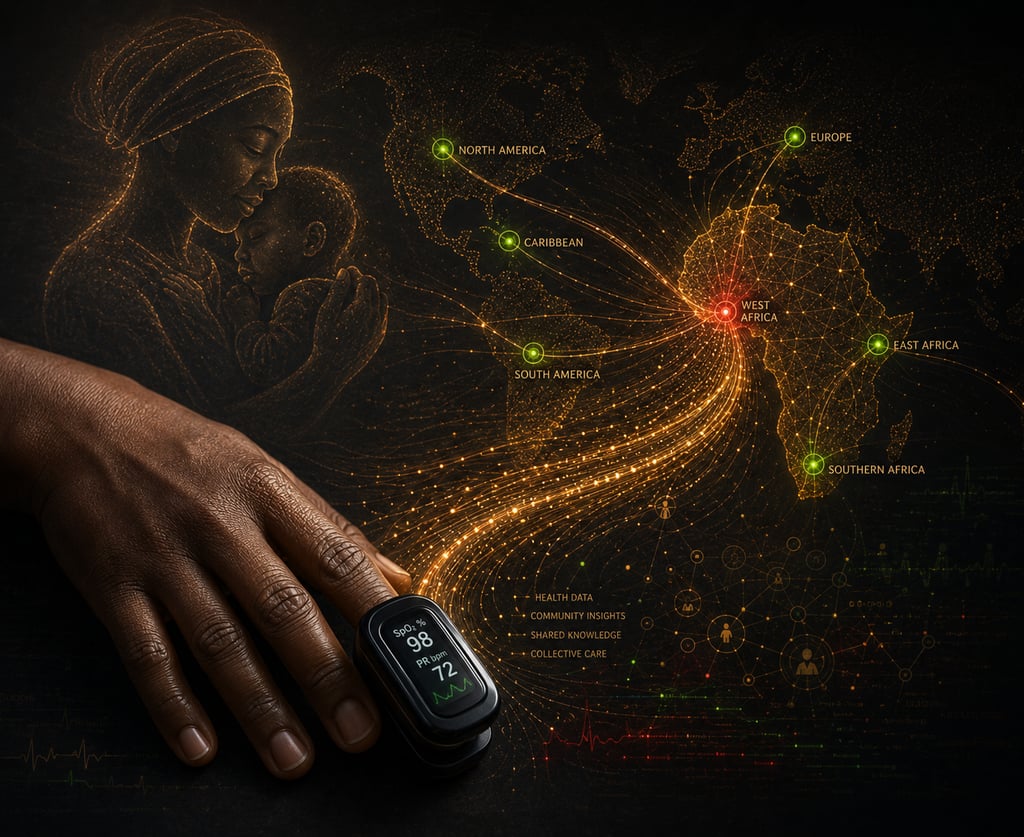
Some discrimination is now engineered into the equipment itself. The pulse oximeter, the small device clipped to a finger to read blood oxygen, overestimates oxygen levels in patients with darker skin. Studies have shown this since 1990, yet the findings were largely ignored and even denied by manufacturers and regulators for decades.

During the pandemic the cost became undeniable. A 2020 study in the New England Journal of Medicine found the device masked the need for treatment in Black patients more often than in White patients, meaning people who needed supplemental oxygen and therapies were less likely to receive them. The federal regulator only moved toward improving accuracy across skin tones in early 2025. A flaw known for thirty years was addressed only when the bodies became impossible to ignore. The same pattern is now repeating in software, where diagnostic algorithms trained mostly on non African data perform less accurately for Black and African descended patients.

A flaw known for thirty years was fixed only when the bodies became impossible to ignore.

The Data Sovereignty Toolkit

Community owned data cooperatives. Structures that hold health and genomic data under community governance, protect privacy, set the rules for ethical use, and ensure that insight generated from our bodies serves our people.

Validation as a condition of use. Requiring that any device or algorithm prove accuracy across skin tones and ancestries before it is trusted in community owned institutions, so that biased tools are caught before they cause harm.

Black led health technology. Investing in the engineers, data scientists, and biotechnology ventures who build the next generation of tools, so that the people building the machine answer to the community.

Our biological information is one of the most valuable assets in modern medicine. The only question is whether it is mined from us or held by us.

Reclaiming the Mind

The most urgent emergency in Black health may be the one the community has been most trained to hide. Mental health has been stigmatized within, underserved without, and distorted by bias in the very rooms where diagnoses are made.

The crisis is measurable and accelerating, especially among the young. The suicide rate among Black adolescents rose dramatically over the past two decades, faster than for any other group, and Black children in the youngest age ranges are now markedly more likely to die by suicide than their White peers. Yet only about a quarter of Black people seek mental health care, compared with roughly 40 percent of White people, and only about 2 percent of psychologists are Black.

Even when care is sought, bias shapes the outcome. A study at Rutgers found that Black Americans with severe depression are far more likely than White patients to be misdiagnosed with schizophrenia, because clinicians overemphasize psychotic symptoms and overlook mood symptoms in Black patients. The consequences compound. Misdiagnosed patients are more likely to be hospitalized, given higher doses of antipsychotic medication, and left untreated for the condition they actually have. Reviews of the research found the disparity did not improve across more than three decades. The cause is not genetic. It is the judgment exercised in the room.

Telling people to simply seek help is hollow when the help available may misdiagnose them, overmedicate them, and miss the depression underneath. Trust is the precondition for care, and trust cannot be imported. The sovereignty response is a Black mental health workforce, care delivered where people already gather through schools, churches, and community centers, and diagnostic protocols that weigh mood and trauma rather than defaulting to the most severe interpretation.

Birth Justice and the Sovereign Body

No statistic indicts the system more completely than the maternal one, because it touches the beginning of life and it does not bend to money or education. Black women in the United States die from pregnancy related causes at three to four times the rate of White women, and the gap persists across income and education. It is reinforced by a long documented pattern of Black patients being undertreated for pain and having their concerns dismissed.

The maternal gap is a concentrated version of every theme in this work. It reflects the cumulative stress that wears the body down before pregnancy even begins. It reflects bias in the room, where a mother's report of pain or alarm is more likely to be discounted. And it reflects the absence of community controlled infrastructure, leaving mothers to give birth inside systems where no advocate of their own is present.

The corrective is not a single program. It is the placement of trusted, community rooted support at every stage. Community based midwifery and birth centers that treat Black mothers as the standard of care rather than the exception. Doula networks that place a trained, trusted advocate in the room where dismissal occurs. Community health workers who extend prenatal and postpartum support into the home.

A mother does not need the system to feel more sympathy. She needs an advocate of her own in the room.

Case Study: The Southern Midwife Tradition

For generations across the American South, Black lay midwives, often called granny midwives, delivered the majority of babies in their communities, Black and White alike, in regions where hospitals were segregated, distant, or hostile. Carrying deep practical knowledge, they provided prenatal guidance, attended births, and supported mothers afterward, sustaining maternal care where the formal system offered little.

As birth was moved into hospitals through the mid twentieth century, this tradition was actively suppressed and largely dismantled, and much of the trusted, community rooted maternal care it represented was lost. The community once held the infrastructure of birth, rooted in trust and local knowledge, and its loss was not a natural evolution. It was a displacement. The contemporary birth justice movement, with its renewed emphasis on midwifery, birth centers, and doulas, is in part the work of rebuilding what was taken, this time owned and governed by the community itself.

One Body, Many Shores: The Diaspora Data Commons

Data sovereignty cannot stop at a single community, because the tools that misread Black bodies were built on data that left African and African descended people out almost entirely. The large majority of participants in genomic and clinical research are of European descent, which means the reference for what counts as a normal body, a normal dose, or a normal reading is rarely ours. A device or algorithm validated on that data will keep misjudging us no matter how many times it is patched.

The answer is to build the dataset ourselves, at the only scale large enough to matter, which is the diaspora. Picture a network of community owned clinics across Atlanta, Kingston, London, Lagos, and Accra, linked by a shared telehealth platform and a community governed data commons. Care reaches patients across borders. Research into Black and African physiology is conducted with the community rather than about it, on terms the community sets, with consent and benefit flowing back to the people the data came from. The same information now mined from us becomes the foundation for medicine designed around us.

The diaspora is the only dataset large enough to correct the science that was built without us.

From Subject to Owner

Across all three frontiers the lesson is identical. Waiting for the manufacturers, the institutions, and the systems to fix themselves is not a strategy. It is how three decades of pulse oximeter harm, thirty years of unimproved misdiagnosis, and generations of maternal loss accumulated while everyone agreed the problem was real.

A community that does not own its health data will be misread by every tool built from it. A community that hands its mental suffering to a system it has no reason to trust will be overmedicated and misread. A community that gives birth inside someone else's hospital, with no advocate of its own, will keep burying its mothers. The shift, everywhere, is from being the subject of the system to being its owner. The same technology that has misread and extracted from Black bodies can be turned to heal them, but only when the community holds the controls and sets the terms.

The Bantaba: Questions for the Circle

  • The pulse oximeter was wrong for thirty years and stayed in use. What other tools are we trusting that were never validated for us?

  • Who currently holds the genetic and health data generated by your community, and what would benefit sharing actually look like?

  • If trust cannot be imported, what would it take to build mental health care your community would actually use?

  • The granny midwives were displaced, not outdated. What trusted knowledge in your community has been suppressed and is worth reclaiming?

  • What is one place where you can move from being a subject of the system to a part owner of it?

Recommended Reading

  • The Immortal Life of Henrietta Lacks by Rebecca Skloot, on consent, data, and ownership of the Black body.

  • Killing the Black Body by Dorothy Roberts, on reproduction, race, and the law.

  • Listen to Me Good: The Story of an Alabama Midwife by Margaret Charles Smith and Linda Janet Holmes.

  • Racial Bias in Pulse Oximetry Measurement by Sjoding and colleagues, New England Journal of Medicine, 2020, on how a standard device misreads oxygen levels in darker skin.

  • A Naturalistic Study of Racial Disparities in Diagnoses at an Outpatient Behavioral Health Clinic by Gara and colleagues, Psychiatric Services, 2019, on the overdiagnosis of schizophrenia in Black patients.

  • Healthcare Sovereignty: The Sovereign Body, Volume 5 of The Sovereignty Series by The Black Metrics, Chapters 8 through 12.

Hold the Controls, Set the Terms

Data sovereignty, mental health, birth justice, cultural medicine, and the global diaspora network are mapped in full in Healthcare Sovereignty: The Sovereign Body, Volume 5 of The Sovereignty Series. Each chapter closes with a documented case study, and the volume ends with a Strategic Assessment Checklist so you can measure where your community stands.

Get Healthcare Sovereignty, Vol. 5

Next month: Housing Sovereignty, Own the Land. Vol. 6 drops July 2026. Sovereignty starts with the ground beneath us.

→ Watch the companion video on YouTube

The June Series: Healthcare Sovereignty

June 1 Surviving Sickness Is Not SovereigntyJune 8 The Biology of OppressionJune 15 They Already Built the Blueprint June 22 The Trillion Dollar BodyJune 29 Whose Data Is Your Body (You Are Here)

THE BLUEPRINT

Contact

support@theblackmetrics.space

Copyright © 2026 The Black Metrics. All Rights Reserved.

The BlaCK METRICS

Fanbase Icon on footerFanbase Icon on footer
Spill app imageSpill app image